Choosing the proper cooling tower configuration is essential in industrial and high-demand environments. The way you specify your system, crossflow or counterflow, directly influences performance, water savings, and site layout. At
Thermal Flow, we are a
cooling tower manufacturer that supports engineers and plant leaders across USA and Latin America, always focused on reliable operation and measurable results.
In this technical overview, you will get a clear, data-backed explanation of each system's structure, benefits, and practical tradeoffs, so you can make the best decision for your exact site and business objectives.
What is a crossflow cooling tower
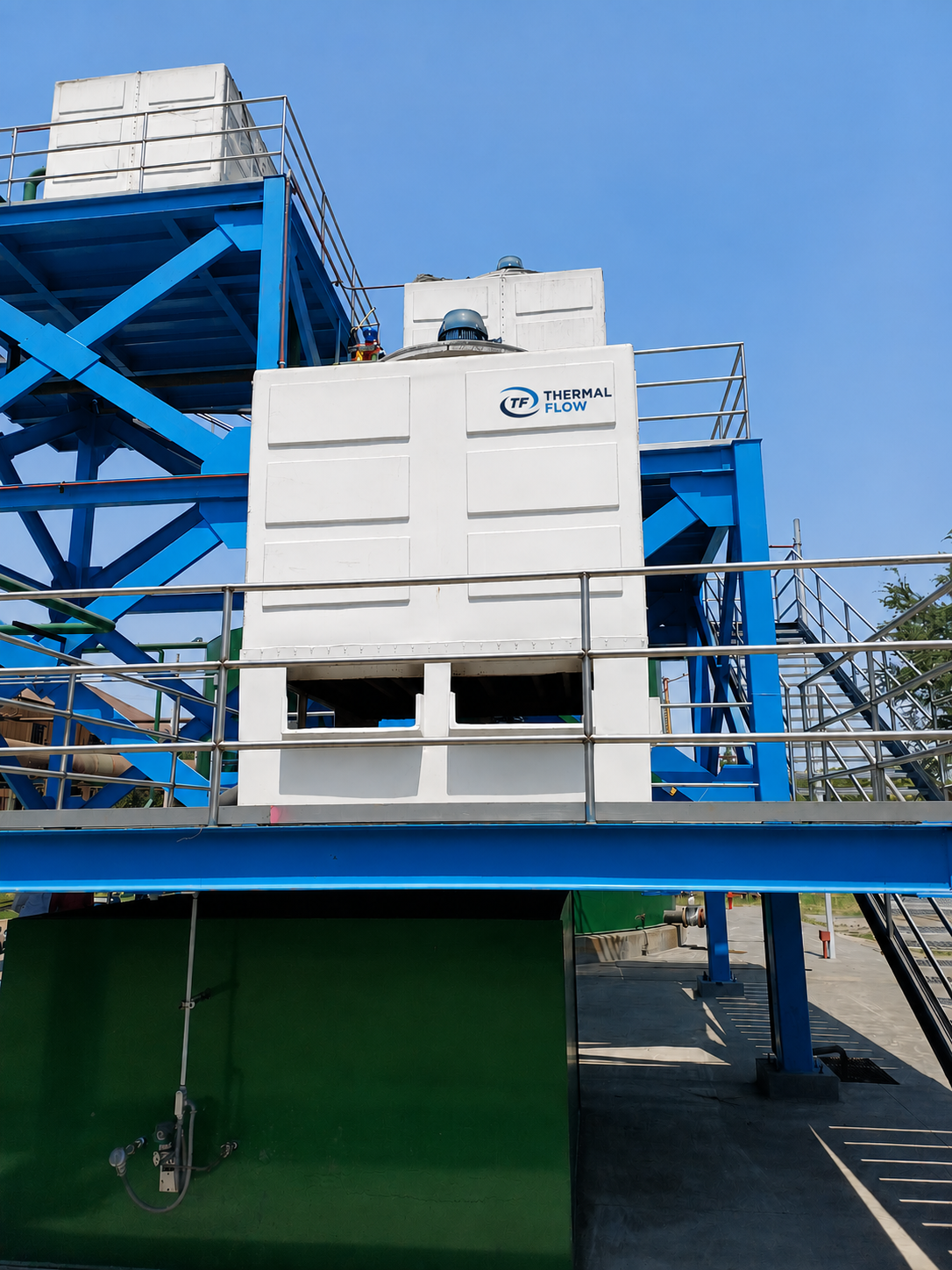
A crossflow cooling tower uses a design where air passes horizontally through the fill as hot process water falls from the distribution basin above. The result is an open and accessible system, with air and water moving at a right angle. Water drips down by gravity, and air is drawn in at the sides by fans. This setup offers straightforward inspection, quick maintenance, and consistent performance, especially in facilities where reliable operation and rapid service matter.
What is a counterflow cooling tower
A counterflow cooling tower operates with the air stream flowing vertically upward, directly opposite to the downward movement of pressurized water. In this system, water is sprayed from above through nozzles, while powerful fans at the base pull air up through the fill. The true countercurrent interaction between air and water supports deeper fill beds, higher efficiency, more compact structures, and can achieve colder water return, supporting demanding industrial applications.
Difference between crossflow and counterflow cooling towers
Crossflow cooling towers depend on gravity-fed open basins, while counterflow towers use closed-pressurized nozzles. The direction of air and water movement is the main separator, in crossflow, air moves sideways across falling water, in counterflow, air moves directly upward, against the spray. Access, site space, and maintenance practices are also very different. For bigger-picture details about cooling tower fundamentals, referencing
What Is a Cooling Tower? Understanding Industrial Cooling Systems gives helpful context for system selection.
Advantages of crossflow cooling towers
- Simple gravity-driven water distribution, lower risk of nozzle fouling, and easier maintenance routines,
- Open fill access supports fast inspection and cleaning without taking the system offline,
- Lower energy use in most configurations, often requires less pump pressure and smaller fans,
- Handles water with variable quality and can tolerate higher suspended solids,
- Ideal for large facilities where available land is not an issue.
Disadvantages of crossflow cooling towers
- Requires a larger footprint for the same cooling capacity as a counterflow system,
- More sensitive to wind drift and possible splash-out if not correctly designed,
- Can experience air distribution variation, sometimes resulting in minor temperature differences inside the tower.
Advantages of counterflow cooling towers
- True countercurrent air and water flow for maximum thermal efficiency,
- Significantly reduced site area needed per ton of cooling,
- Produces colder water, even in tough climate or process scenarios,
- Modular, flexible, and well suited to power, chemical, and data center projects.
Disadvantages of counterflow cooling towers
- Requires higher pump pressures and energy input to maintain water sprays,
- Fill and spray areas are harder to access for cleaning or upgrades,
- Sensitive to water quality, increased risk of nozzle clogging,
- Can show higher fan energy demand for deep fill or “tight approach” systems.
Which cooling tower design is better for industrial applications
There is no single answer for every facility. Crossflow cooling towers dominate in heavy industry, metals processing, and large-scale plants where downtime and maintenance speed are critical. Counterflow is the preferred option where land value, energy use, and cold temperature output drive the investment. Many industrial plants operate both in parallel, each optimized for its duty, process constraints, and water chemistry.
Applications and selection criteria for crossflow vs counterflow
- Crossflow cooling towers work best for refineries, steel plants, and sites with open space, moderate energy costs, and the need for fast, visual stage checks,
- Counterflow cooling towers win out in energy generation, data centers, and modular multi-cell projects with limited real estate and exacting thermal specs,
- Proper selection depends on required cooling load, allowed footprint, local water conditions, operating patterns, and lifecycle economics.
How to choose the right cooling tower for your facility
Start with a process heat load audit, check regulatory and environmental limits, and define how water quality and space layout affect your choices. If you need non-stop uptime, reliable operation, and scalable performance, working with technical specialists in
industrial cooling tower design helps translate plant data into optimal equipment selection.
Maintenance and operational tips for each type
Crossflow systems allow direct inspection of fill, fans, and basins, keep drift eliminators and water distribution clear, and schedule routine checks monthly. Counterflow systems must prioritize nozzle health, spray pattern checks, and fill loading balance, even when access is more limited. Both types demand consistent water treatment, regular fishwater monitoring, and full basin cleaning during shutdowns, all to protect your
industrial cooling tower assets, maximize lifecycle, and control total operating costs.
Request your technical evaluation for your next industrial cooling tower
If your team wants evidence-based guidance for industrial cooling tower selection, or you are facing complex performance or site limitations, talk with a proven engineering specialist at
Thermal Flow. Get the results only expert diagnostics and a custom-built
industrial cooling tower can deliver.